
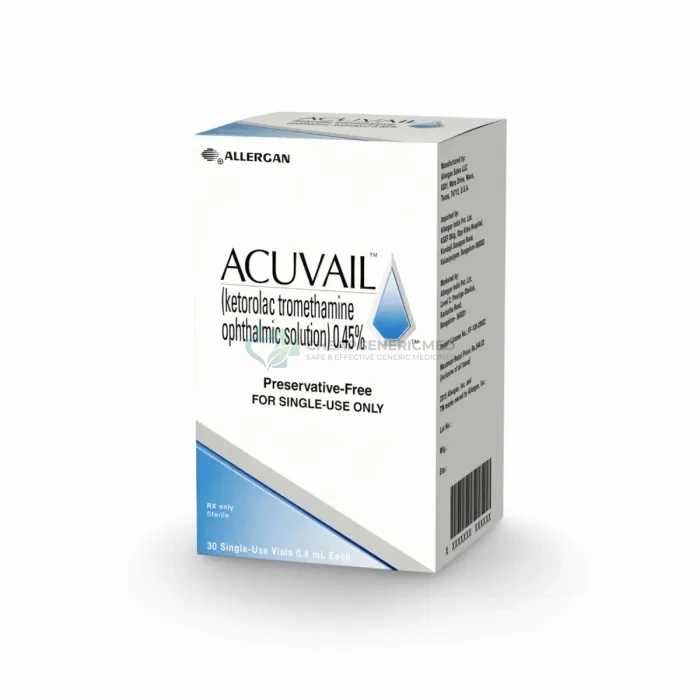


Acuvail Eye 15S 0.4 ml (Ketorolac)
Price range: $54.71 through $164.51Required
| Pack Size | Price | Unit Price | Quantity | |
|---|---|---|---|---|
| 1 Eye Drop | $54.71 | $54.71 / eye drop | ||
| 3 Eye Drop | $101.37 | $33.79 / eye drop | ||
| 6 Eye Drop | $164.51 | $27.42 / eye drop |
About Acuvail Eye 15S 0.4 ml (Ketorolac)
Medicine information
- Active ingredient
- Ketorolac tromethamine
- Indication
- Treatment of pain and inflammation following cataract surgery.
- Packaging
- 15 single-dose ophthalmic solution units, 0.4 mL each
- Strength
- 0.45 %
- Dosage form
- Ophthalmic solution in single-dose vial
- Route
- Ophthalmic
Medicine overview
Acuvail is a sterile ophthalmic solution containing ketorolac tromethamine 0.45% (4.5 mg/mL). Ketorolac is a nonsteroidal anti-inflammatory drug (NSAID) used in the eye to control pain and inflammation associated with cataract surgery. The formulation is preservative-free and supplied in single-dose units. It works locally by reducing the production of prostaglandins, substances involved in inflammation and pain. Acuvail is a prescription medicine and should be used according to the ophthalmologist's instructions.
What it is used for
Acuvail is indicated for treating pain and inflammation following cataract surgery. By reducing the inflammatory response in the operated eye, ketorolac can help control postoperative eye discomfort, redness, and inflammation. The verified prescribing information supports this postoperative cataract-surgery indication; use for other eye conditions should not be assumed from this product information.
How it works
Ketorolac is an NSAID. Its anti-inflammatory action is thought to result from inhibition of prostaglandin production. Prostaglandins are naturally produced substances that contribute to pain and inflammation after tissue injury or surgery. When ketorolac is applied to the eye, reducing prostaglandin production helps limit the inflammatory response and associated pain after cataract surgery.
How it is taken
Acuvail is for use in the affected eye only. The verified prescribing information directs one drop into the affected eye twice daily, beginning one day before cataract surgery, continuing on the day of surgery and through the first two weeks after surgery. Follow the prescribing ophthalmologist's directions. If other topical eye medicines are being used, administer them at least 5 minutes apart. Use an individual single-dose vial immediately after opening and discard any remaining solution. Do not allow the vial tip to touch the eye or surrounding surfaces, and do not administer Acuvail while wearing contact lenses.
Important warnings
Do not use Acuvail if you have a known hypersensitivity to ketorolac or another ingredient in the formulation. Cross-sensitivity can occur in people who are sensitive to aspirin, phenylacetic acid derivatives, or other NSAIDs. Topical NSAIDs may delay healing, and using them with topical corticosteroids may increase this risk. Ketorolac can interfere with platelet aggregation and may increase bleeding time, requiring particular caution in people with a tendency to bleed or those taking medicines that prolong bleeding. Ophthalmic NSAIDs can cause keratitis and, in susceptible patients, serious corneal complications including epithelial breakdown, thinning, erosion, ulceration, or perforation; risk can increase with prolonged use beyond the recommended period. Avoid touching the vial tip to the eye or other surfaces because contamination can cause serious ocular infection. Seek prompt medical assessment for worsening eye pain, marked redness or swelling, significant visual changes, signs of an allergic reaction, or symptoms suggesting infection or corneal injury.
Side effects and monitoring
Common adverse reactions reported in clinical trials included increased intraocular pressure, conjunctival redness or hemorrhage, corneal swelling, eye pain, headache, tearing, and blurred vision; these occurred in about 1% to 6% of patients, and some may also have been related to cataract surgery itself. Allergic reactions including eye swelling, redness, and itching have also occurred. Serious postmarketing eye reactions include corneal erosion, thinning, perforation or melt, epithelial breakdown, and ulcerative keratitis; bronchospasm and worsening asthma have also been reported. Persistent or severe eye pain, worsening vision, breathing difficulty, substantial swelling, or other signs of hypersensitivity require prompt medical attention. Patients receiving postoperative treatment should attend the eye follow-up and monitoring arranged by their ophthalmologist.
Pregnancy
There are no adequate and well-controlled studies of Acuvail in pregnant women. The prescribing information reports no evidence of teratogenicity in rats or rabbits at clinically relevant doses. Use during pregnancy should therefore be considered with appropriate medical guidance.
Breastfeeding
It is not known whether ketorolac administered topically to the eye is present in human milk. The prescribing information advises caution when Acuvail is administered to a nursing woman.
Storage
Store at 15°C to 30°C (59°F to 86°F). Keep the single-dose vials inside the pouch and protected from light, with the pouch ends folded closed. Use an individual vial immediately after opening and discard any solution remaining after use.
Frequently asked questions
Why do ketorolac eye drops sometimes sting or irritate my eye?
Eye discomfort can occur during treatment. Clinical studies with Acuvail reported eye pain, tearing and other ocular reactions, while allergic reactions can cause swelling, redness or itching. Persistent or severe pain, worsening redness, or changes in vision should be assessed promptly by an eye-care professional.
How long is Acuvail normally used around cataract surgery?
The verified Acuvail regimen begins one day before cataract surgery, continues on the day of surgery, and runs through the first two weeks after surgery. Use it for the period prescribed by your ophthalmologist rather than extending treatment yourself.
Can Acuvail cause blurred vision after I put it in?
Yes. Blurred vision was among the adverse reactions reported in clinical trials. New, severe, or persistent deterioration in vision should be reported promptly because ophthalmic NSAIDs can also cause more serious corneal problems.
Can I use Acuvail with my other prescription eye drops?
Acuvail can be used with several other topical ophthalmic medicines when prescribed together. The prescribing information states that different eye drops should be administered at least 5 minutes apart.
Can I reuse a 0.4 mL Acuvail single-dose vial?
No. An individual single-dose vial should be used immediately after opening, and any solution remaining afterward should be discarded. Avoid touching the vial tip to your eye or nearby surfaces because contamination can lead to serious eye infection.
Can I wear contact lenses while using Acuvail?
Do not administer Acuvail while wearing contact lenses. Follow your ophthalmologist's instructions about when contact-lens wear can safely resume after eye surgery.
What eye symptoms need urgent medical attention while using Acuvail?
Seek prompt medical assessment for severe or worsening eye pain, significant changes in vision, marked swelling or redness, or suspected infection. Serious corneal injury and hypersensitivity reactions have been reported with ophthalmic ketorolac.
Will I receive tracking if Acuvail is shipped internationally by Cheap Generic Med?
Under the standard store fulfilment model, tracked international shipping is used and a tracking number should be provided after dispatch. Carrier systems may take 24–72 hours to begin showing movement.
Is Acuvail a prescription medicine?
Yes. Acuvail is classified as a prescription medicine in the verified U.S. product labeling. Prescription and import requirements can differ between countries.
Sources
Medical information notice: This information does not replace advice from a qualified healthcare professional. Use prescription medicine only as directed by the prescriber and the approved product information.
| Packaging | Qty |
|---|---|
| Delivery Time | 6 To 15 days |
Related products

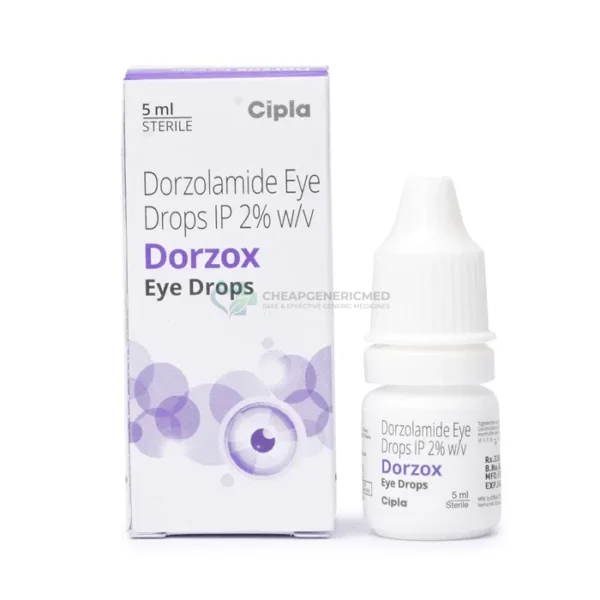
Dorzox Eye Drop 2% (5 ml) Eye Drop (Dorzolamide)


Dorzox T 5 ml Eye Drop (Dorzolamide)

Genticyn Eye Drop 5 ml (0.3%+0.02%)


Megabrom Eye Drop 5 ml (Bromfenac)
Ns Aid 5 ml Eye Drop (Diclofenac Sodium)

Oflox 5 ml (Ofloxacin)


Reviews
There are no reviews yet.